

Ready for Financial Confidence?

Many owners who call us open with the same request. They want a CPA. Sometimes that’s right. Often, they need more than that, or something else entirely. It’s easy to select the most identifiable acronym without reviewing the options, and you can hire the wrong help for where you stand.
The confusion is fair. These three roles get lumped together because they all touch your financial data. But they do fundamentally different jobs, they get paid differently, and the decision to bring one in-house versus hire it out has nothing to do with which one you pick. Seeing a business from the outside, a few times a year through the lens of a tax return, is a very different job from operating inside one. Let’s go through the three roles, what each one delivers, the stage of business that benefits from it, and how to determine what your small business can afford now.
What does a CPA do?
A CPA is a licensed accountant. Their job is accuracy and compliance: preparing financial statements, filing your returns, and making sure you’re square with the IRS. So CPAs deal with historical data by design. They tell you what happened.
That’s foundational. Clean, defensible books make your business audit-ready, and that’s a strength everyone needs. But their training and incentives point backward. Ask a compliance-focused CPA about what your gross margin trend says about pricing, and you may get a shrug, because that’s not their job.
Some CPA firms offer bookkeeping as a service, especially for businesses that don’t have anyone in-house handling the books day to day. That’s a separate offering from the tax and compliance work, even when it comes from the same firm.
If you’re a new founder or a lean team, then a CPA may fit your business needs best to start. The business is making money, and the tax implications have grown past what you can handle in a spreadsheet. Your goal here is to maintain order with records that you can trust to survive an audit.
A CPA reports the score after the game. Coaching the next quarter falls to someone else.
What is a Tax Advisor, and When Do You Need One?
Widen the lens, and you reach advisory-level needs. A tax advisor stops staring at a single return and starts tracing how your choices have connected over the years. The annual filing records what happened, but advisory shapes what comes next. This is proactive tax strategy, entity structure, the timing of major purchases and distributions, retirement and succession planning, and how your personal and business finances feed into each other.
Most major financial decisions carry a tax consequence, but the most expensive ones tend to stem from moves owners make without first modeling the bill. Advisory helps to alleviate that problem. A tax advisor before you buy the building, add the entity, or sell a stake.
Tax advisory tends to show up later for a practical reason: it’s usually billed hourly or by retainer, which only makes sense once there’s enough complexity, and enough at stake, to justify the ongoing spend. Once your small business is established and you’ve become profitable, then you’re working with real money.
That’s when it’s time to plan around the recurring decisions on the pricing model. You’re looking at multi-year tax tails and a personal balance sheet that has grown alongside the company. So your goal has to evolve from order to include strategy.
Ultimately, you want to keep more of what you own as you grow.
What is a Fractional CFO, and What Do They Do?
A fractional CFO provides financial leadership. It is not an expanded accountant. The role considers operational and strategic elements from a financial standpoint to guide senior management toward the company goals. While that can include tax, treasury, and cash flow, the fractional CFO supports planning and decision making rather than tax prep or auditing.
Growth eventually raises questions that a monthly close cannot answer, such as what happens next and what we should do about it. Those kinds of strategic planning questions belong to a CFO. Many small businesses have never had one because a full-time CFO is out of budget. But a fractional CFO provides the expertise without the salary punch.
A CFO takes your track record and works forward. They layer in industry benchmarks, best practices, and your own pipeline of work. Then, they build the models that drive decisions. In practice, this looks like rolling cash flow forecasts, budget-to-actual tracking, scenario modeling for a hire, a lease, or a new location, and a running answer to ‘what does this decision to the next twelve months.’ A CFO takes the CPA’s clean historical record and turns it into a forward-looking model.
Neither role replaces the other.
What Does Your Small Business Need Right Now?
CPA vs. Tax Advisor
Both are usually credentialed the same way, and often the same person can hold both hats. The difference is timing and posture. A CPA files what already happened. A tax advisor plans what hasn’t happened yet. Businesses at almost any stage need the CPA function; the advisory layer becomes worth paying for once decisions carry greater tax weight.
CPA vs. Fractional CFO
This is the comparison people confuse most because CPA firms increasingly market “CFO services” alongside their compliance work. Be careful here. A CPA firm offering CFO-adjacent services still thinks, in many cases, like an accountant: accurate, compliant, backward-looking. A true fractional CFO thinks like an operator: what lever do we pull, and what does it cost us if we don’t. Ask what specific deliverables come with a “CFO service” add-on before assuming it does what a dedicated CFO does.
Tax Advisor vs. Fractional CFO
With a tax advisor, every question routes back to the tax bill. That’s their main focus. A CFO’s lens considers the entire company. Tax is one input among many, alongside pricing, staffing, cash timing, and growth capacity. A CFO who never talks about your tax exposure at all probably isn’t doing the job well, but tax is not the organizing question the way it is for a tax advisor.
Often, a business requires both as each role offers distinct benefits that compliment the other. A CPA keeps the books right and the filings sound. A tax advisor keeps decisions from creating tax surprises. A CFO makes sure the numbers both of them produce actually drive what the business does next.
When Can Your Business Afford Each One?
We often see guidance that frames this decision around the business stage when budget is the driving factor. The pricing of these services varies widely, so consider what works best based on your affordability.
- Bookkeeping and CPA work are the entry point for almost every business.
From day one, regardless of size. If you’re not a numbers person, or you don’t have the time, this isn’t optional. It’s the cost of staying compliant. Bookkeeping alone typically runs a few hundred to a couple thousand dollars a month depending on transaction volume and complexity. A straightforward annual return adds a few hundred to a few thousand more. This is usually the cheapest of the three, but it’s also the one you cannot afford to skip.
- Tax advisory becomes affordable when a modeled decision saves more than it costs.
As an hourly service or retainer, tax advisory is naturally gated by how much value is on the table. If a single entity restructure or a well-timed purchase saves five figures in tax, the advisory fee pays for itself many times over. If your business is still simple, one entity, one revenue stream, no transaction on the horizon, you likely don’t have enough at stake yet to justify the spend.
- When financial decisions produce a return bigger than the fee, Fractional CFO works.
Fractional CFO work carries the highest price tag of the three, typically running a few thousand to well over ten thousand dollars a month depending on scope and hours. That’s significant money for a small business. That changes the affordability question from “can I technically pay this?” to “will better financial decisions produce a return bigger than the fee?” If avoiding one bad hire, one cash crunch, or one mispriced contract would cover months of the engagement, it’s affordable. If you’re paying for insight you don’t yet have the complexity to act on, it isn’t yet.
What are some indicators a business needs Fractional CFO services?
Rapid expansion, margin pressure, a system overhaul, or preparation for a major transaction indicate complex growth that would benefit from a fractional CFO. The decisions you’re facing overshadow the tools and expertise you currently have at your disposal. You’re looking for someone who has operated inside a business with real pressure and stakes.
Let me paint a picture of the owner who is ready. They’re winning, and they’re drowning. Revenue’s climbing, but cash feels tight, and they can’t tell you why. They’re tired of guessing and going at it alone. What they want is a co-pilot who can look twelve months out and say, here’s where you’re headed, and here’s the level to pull now.
The push often comes from outside. A lender or a buyer asks for numbers the owner can’t produce. A bank wants a forecast before extending the line of credit. Someone wants the financials reviewed, and the owner’s setup can’t generate them. Growth applies the same pressure. They land a contract bigger than anything they’ve handled, and it strains everything: cash, staffing, timing, etc. The pressure comes from outside, but it’s not the cause of the problem. It’s exposing the gaps that were there all along.
At Attracct, we run rolling 13-week cash flow models, an annual budget tracked against monthly actuals, and a rolling 12-month forecast with scenario and sensitivity analysis. We work with your pipeline to sharpen revenue timing and determine which projects make money and which ones need to be left behind. With a fractional CFO, you get more freedom of choice because you can see where the business is headed while you can change course.
In-House vs. Outsourced
This matters as much as which service you’re buying. Choosing the cheapest option on paper shorts your potential. Consider instead: how much of this expertise do you need, how often, and is the gap between full-time and fractional wide enough to matter? For most small businesses, on all three fronts, it is.
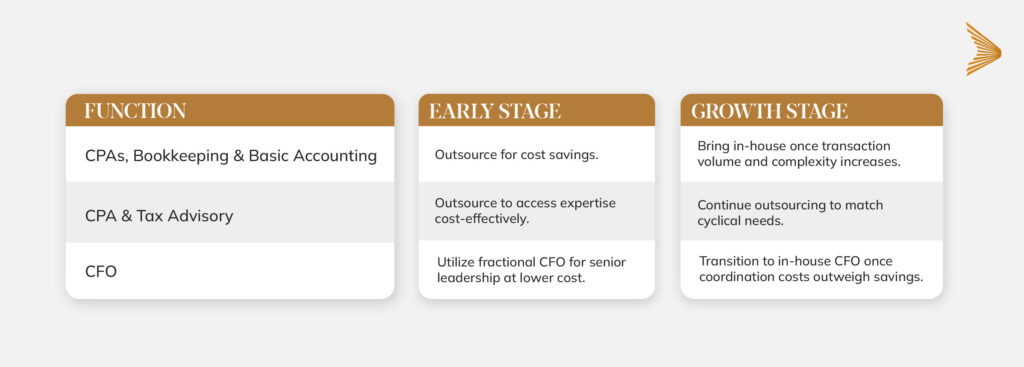
Why Keep CPA, Advisory, and CFO Work Under One Firm?
For a business that keeps growing, the answer is rarely one role standing alone. Your CPA’s tax knowledge sharpens the CFO’s planning. The CFO’s operating view feeds the CPA better raw material. When they work together, they share what they know instead of leaving you to ferry the information from one outside vendor to another.
We built Attracct to scale with the client for that reason. Watch how it usually goes elsewhere: an owner outgrows the bookkeeper and hunts down a CPA. Outgrows the CPA and goes looking for an advisor. Every jump means starting over, re-explaining your business to a stranger who’s learning it from scratch while you pay them to catch up.
You skip that with us. You start with clean accounting with our CPAs, and as the decisions get heavier, we add advisory, then CFO work, with the same people who’ve watched your numbers the whole way. The person modeling your next twelve months already knows the bet you made three years ago and how it played out. You don’t have to rebuild your financial team or stitch three vendors together to get a straight answer.
You’re working with the same people with deeper capability, phased to where your business stands.
Which do you need: CPA, tax advisor, or fractional CFO?
Read back through the three descriptions and locate yourself.
If tax season scares you and the books feel shaky, start with clean accounting and a CPA to get your foundation right.
Maybe your income and decisions have outgrown a single return, you are ready for advisory services.
If growth is straining your cash and clouding your view of next month, you need CFO insights.
You don’t have to solve all three questions at once, and you don’t have to hire full-time to get any of them. Consider the decision that’s left you stuck and which of these roles is built to provide a solution.
Solve Your Problem with the Right Service Tier
We built our firm to cover all three of these, CPA, tax advisory, and fractional CFO, under one roof. Most firms hand you one of these three and leave you to find the other two when you outgrow them. We would rather grow the relationship as you grow the company, so the person who knows your numbers in year one still knows them in year seven.
You are the one running the business. Our job is to guide the financial side while you do it. Find out where your business sits, and let’s figure out where your business is going next.
Frequently asked questions
Start where you are. Most clients begin with one and add the others as the business grows. If the books are the problem, we start there. If growth is the pressure, we start with CFO work and bolster the accounting foundation beneath it.
Your preparer records what already happened and files it correctly. A tax advisor works ahead of the return, shaping decisions before you make them, so the bill is smaller when it lands.
The trigger is complexity, not necessarily revenue. When your decisions start outrunning what a monthly close can answer, rapid growth, a transaction, tightening margins, you are in CFO range, whatever the top-line number says.
Pricing tracks the scope. A clean monthly accounting engagement costs less than a full CFO relationship with weekly models and forecasting. We scope it to your stage and give you the number before you commit, the same way we would want a tax bill modeled before a big decision.
Less than dealing with it yourself. Expect a monthly review at the base level, and weekly touchpoints once CFO work is involved. We handle the deliverables and bring you the decisions, so your hours go toward reading the numbers rather than building them.
