

Ready for Financial Confidence?

Builder work pays less. True or false?
Doesn’t matter. That’s what most folks believe. I’ve had this conversation with specialty contractors enough times that I can usually finish the sentence for you. Let’s say you’re a window company, and you’ve got some ongoing partnerships with local production homebuilders.

You handed over ten or fifteen points of margin because the builder promised volume, and that volume was supposed to make up for it on the back end. Some months you look at the P&L and feel pretty good about the trade. Other months you look at the same P&L and start wondering whether you own a small business or a nonprofit that serves production homebuilders.
With the same mechanism, you reach two different conclusions. But how is that possible? It’s because you’re using identical standards for two different sales strategies. Builder work and retrofit work are not two flavors of the same business. They’re two separate business lines that follow very different pathways to provide the same result. Retrofit is retail. You’ve got a showroom, a marketing budget, and a commissioned salesperson, potentially spending two hours at a homeowner’s kitchen table looking at grid patterns. Builder is wholesale. You’ve got an outside rep, a plan set, and forty lots, all in a row.
The distinctions are clear. So why price them the same, target the same margin, or grade them on the same report card? Here’s how to build a more helpful outlook.
Gross margin percent is the wrong yardstick for builder jobs.
Gross margin percent doesn’t give you the full picture of how long the work took or what you spent to get it. Both of those are the whole ballgame in this comparison.
Think about a retrofit day. House built in 1968. Nothing is square, and nobody who framed it is still alive to answer for it. Your crew tarps the furniture, pulls the old units, finds rot behind the trim, and narrates the whole operation to a homeowner who is very interested in the process. Eight openings is a good day. Ten and somebody should buy lunch.
Now imagine a builder production site. Same window repeating down the street. Openings framed to spec. Material staged in the subdivision. No furniture, no homeowner, no surprises in the wall. Twenty openings is just another Tuesday.

If your crew turns two and a half times the volume on a builder day, a 28% job can throw off more gross profit per crew day than a 42% job. But you have to compare apples to apples.
It only works if the productivity gap is real. If your builder jobs are running return trips, sitting around waiting on framing that wasn’t ready, or starting to absorb backcharges, then you are working cheaper while looking busy.
That’s why you have to measure it. Look at the gross profit dollars per crew day, tracked by segment. That single number can settle an argument a company has been having with itself for six years.
What does it cost you to sell the job?
Retrofit typically eats eighteen to twenty-two points of revenue between lead cost and sales comp. Builder work often costs less than five. When that gap actually exists, it’s the strongest argument in favor of builder volume, and yet it’s often not quantified.
Retrofit revenue drags a marketing load. You’re buying leads, running a showroom, paying for the truck wrap and the radio spot, and cutting a commission check when it closes. And all of that happens before a single installer touches a window.
Builder revenue doesn’t work like that at all. An outside rep at $110,000 fully loaded who services $4 million in revenue costs you under three percent, with almost no marketing spend behind him. He isn’t out generating demand. He’s servicing a relationship.
Run them side by side and the picture stops matching the one in your head:
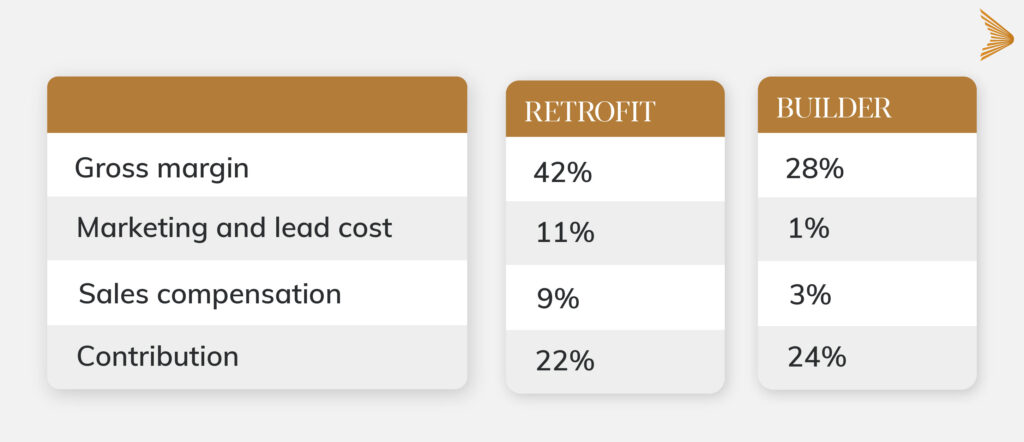
Those are illustrative numbers. Yours will land somewhere else. But the shape is usually right, and that’s the point here. Builder work can carry a lower gross margin and still contribute more because it costs less to buy.
Where it falls apart is when the sales cost stops amortizing. A rep working with twelve builders is efficient. That same rep servicing four is an expensive friendship, and nobody catches it because the P&L never breaks it out.

How should you set contractor payment terms with builders?
Price the float instead of eating it. Make it a stated line item in your builder model. Seventy-five days of float at a ten percent cost of capital runs you roughly two points of margin, so build in the two points instead of effectively donating them.
Homeowners pay you at completion. Builders pay you in sixty to ninety days. That difference is a cost, and right now many simply absorb it and call it the price of doing business. Then, it becomes an issue in December when the line of credit is stressed.
If you’ve never mapped that gap out week by week, Attracct’s free 13-week cash flow forecast is a great tool to see it coming.
Give the builder a choice. Offer 2/10 net 30, 2% off the invoice if they pay within 10 days, full amount due in 30 if they don’t. If faster money is worth something to you, go ahead and buy it out in the open. Some builders will jump on it. The ones who won’t just shared something very useful about their own cash position.
How do you enforce volume commitment?
Quote your standard price and pay the discount backward, as a tiered quarterly rebate on units actually delivered. It’s a straightforward way to protect your business and honor the reality of the deal. The volume you were promised is an achievable goal at best and a sales story at worst. The volume that shows up is a verifiable fact. Only one of those should be priced.
This is the failure point in nearly every builder relationship I’ve ever reviewed. You priced for sixty homes. He built twenty-two. Nobody ever went back and repriced, and the discount just kept right on rolling, quarter after quarter, like a subscription you forgot to cancel.
Flip the structure and the math protects itself. At real volume, the builder nets exactly what he would have gotten under the old handshake, so he has nothing to complain about. At half volume, you keep the margin you should have kept all along.
This is not adversarial, but it requires good communication and business sense. Make sure the deal matches the terms of the deal.
Who actually earns your manufacturer volume rebate?
Usually the builder segment, and typically nobody gives it credit for that. Builder volume is often exactly what pushes your total purchases into a higher tier with the manufacturer, and that tier discount then lowers material cost on every job you run, including the high-margin retrofit work everyone is so proud of.
If you look at it backward, you can end up firing your most valuable segment.
If that rebate drops into other income or spreads evenly across all revenue, the builder segment looks marginal on paper. But it’s really not. It’s subsidizing the numbers you keep using to prove it should go.
Trace the rebate to the volume that generated it before you draw one single conclusion about whether builder work earns its keep.

What is builder base load actually worth?
It’s certainly worth the cost of not rebuilding your crew twice a year. Down here, retrofit demand is seasonal and storm-driven. It surges, and then it goes quiet, and you don’t get much notice either way.
Builder backlog is what keeps your crews busy in the trough. That has real value. You’re not laying off good installers in February and rehiring strangers in May, not paying to train replacements, and not eating the callbacks that come with a green crew learning on your customers.
That is a legitimate reason to accept a lower margin on scheduled base load work.
It is not a reason to accept a lower margin on work that competes head-on with peak retrofit season. A builder job in your busiest month is displacing a forty-two-point job. Price it accordingly, or schedule it at another time.
How should you evaluate individual builders?
The spread between your best builder and your worst builder is almost always wider than the spread between builder work and retrofit overall. So, score them one at a time, on a scorecard, the same way your bank would score you.
Look at gross margin. Return trips per home. Backcharges. Days to pay. Whether the openings are actually ready when your crew rolls up, or whether “ready” is aspirational. How do they behave when there’s a change order on the table?
You’ll find one or two builders carrying the whole segment on their back, and one or two you should have parted ways with two years ago. That report is where the money is hiding.
How do you protect receivables from builder concentration risk?
Credit limits per builder, lien and privilege rights preserved on every job, and billing at delivery instead of trim-out, wherever the contract allows it. One builder failure can erase a year of segment profit and take next year’s growth with it.
No exceptions on the lien rights, either, no matter how warm the relationship feels. The builders who fail rarely look like they’re failing right up until they do.
And if a builder’s own financing looks thin to you, ask for a joint check agreement. Have an awkward conversation now. It’s much cheaper than a potential loss later.
So, is builder work profitable, or not?
It’s profitable when you run it as a separate business, with its own cost structure, pricing model, and scorecard. It turns into an expensive hobby when you run it as retrofit work at a discount and hope the volume covers the difference.
Most owners already have a gut feel for which one they’re doing. What they don’t have is the reporting to prove it, or the appetite for a direct conversation with a builder who isn’t holding up his end. The reporting is the easy part. I can help you with that one.
If you can’t tell me your gross profit per crew day by segment right now, that’s a great place to begin.
Want that reporting built? Let’s sit down to talk.
Frequently Asked Questions
You don’t need new software to begin. Tag every job as builder or retrofit, capture crew-days off the schedule you already keep, and divide segment gross profit by segment crew-days for one quarter.
There’s no universal number, but a good rule of thumb is that no single builder should be able to erase a full quarter of segment profit if they stop paying. Once one builder crosses roughly a quarter to a third of your builder revenue, treat that as a risk to actively manage with tighter credit limits and stricter billing terms.
Bring them the numbers. Remember, it’s not a personal grievance. Show the volume you priced for versus what was delivered, and frame the tiered rebate as the structure that pays them fairly at whatever volume they actually hit. A builder holding up their end technically has nothing to lose in that conversation.
Annual price locks are fine for scheduled base-load work, but tie them to a material escalation clause or a defined review window so a mid-year cost spike doesn’t eat the margin you agreed to. A price good for twelve months and a cost good for twelve months are two different promises.
Enough that his fully loaded cost amortizes down toward the low single digits as a percent of the revenue he services. A rep on a dozen active builders is efficient. If you can’t say how many accounts each rep is really servicing, that’s the first number to pull.
